
Advanced Massage Chair Importer in Panipat
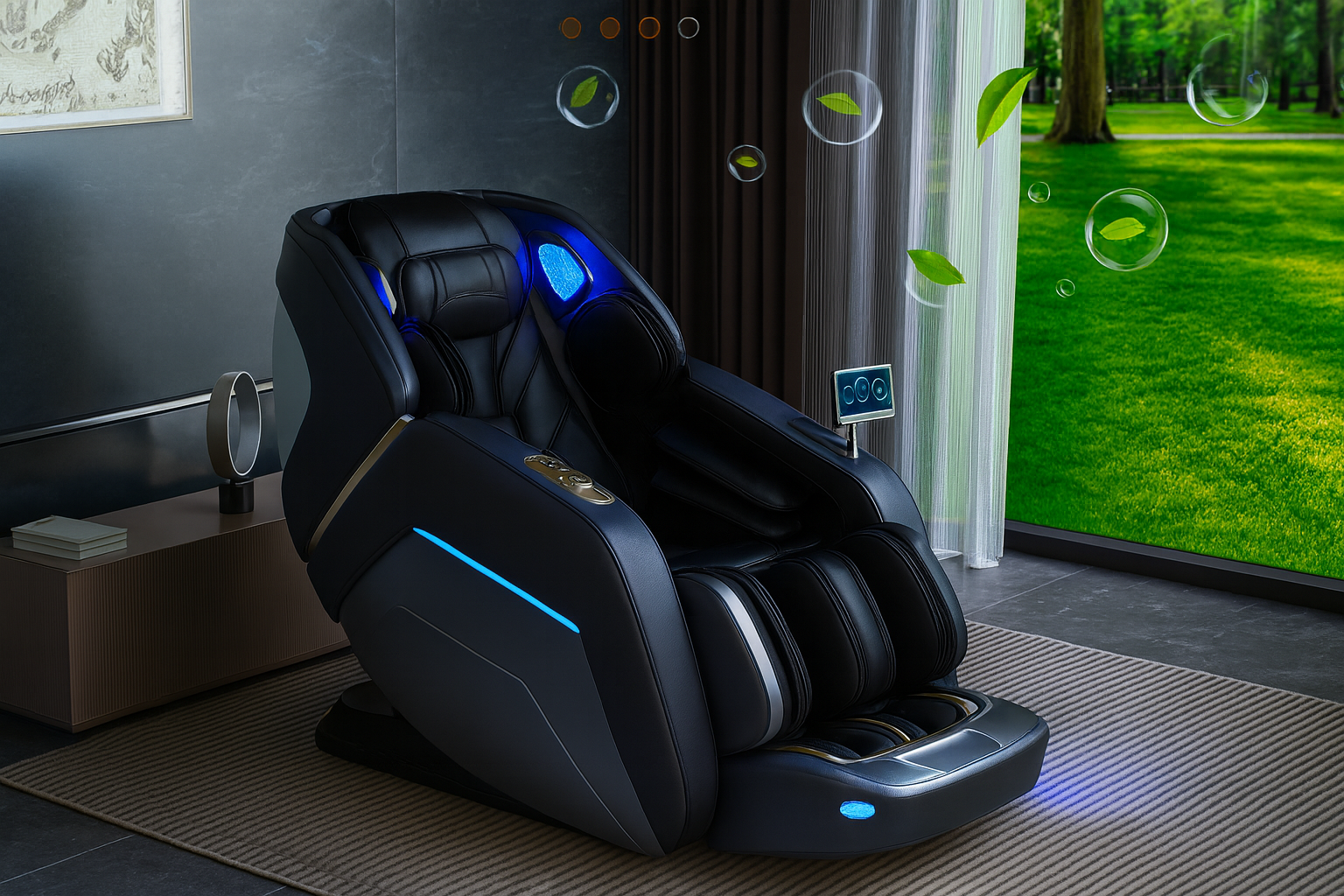
Imported advanced massage chair delivered and installed across Panipat, GT Road, Samalkha, Gharaunda and the Refinery Township belt.
Advanced Massage Chair Importer in Panipat
Panipat is a working city in the truest sense. It is the City of Weavers, the textile and handloom capital that supplies bed linen, carpets and rugs across India and abroad. It is also home to one of the country's largest refineries, a thermal power station, and a GT Road trading economy that has been moving goods north and south for centuries. That produces a very particular kind of daily fatigue — long shifts at a loom, hours on a plant floor, standing behind a counter on NH-44, driving the GT Road corridor, or managing a unit through a peak export season. An advanced massage chair is built for exactly that accumulation, not for a single sore spot.
LVS Massager is a specialist Advanced Massage Chair Importer in Panipat, working with imported SL-track roller systems, genuine 4D mechanisms, AI body scanning, multi-zone airbag compression and reflexology foot rollers — the systems that separate a genuinely advanced chair from a basic kneading seat.
We import directly from vetted international manufacturers, handle customs clearance and BIS-relevant compliance, and deliver to your home in Model Town, the HUDA sectors, Old City, Sondhapur, Tehsil Camp, Insar Bazar, Battal Bazar, Kabul Bagh, GT Road, Samalkha, Gharaunda, Assandh, Madlauda, Israna, Sanoli Road, Panipat Refinery Township or Thermal Colony. Whether you live in a Model Town independent house, a first-floor builder flat in Sector 11–25, or a township quarter near the refinery, our Advanced Massage Chair Importer in Panipat service covers measurement, delivery, installation and after-sales coordination.
Every chair we import is checked for 220–240V Indian voltage compatibility, safety certification and spare-part availability before it enters our showroom near the Delhi border. That matters in a city where imported electronics and textile machinery often move through unofficial channels — a grey-market unit can look identical in a photograph and still leave you with no local support the day a roller motor fails.
Because Panipat households range from young textile-trade couples in the HUDA sectors to large multi-generational homes in the Old City and Model Town, we shortlist models with multi-user profiles so each family member can recall their own program without resetting the chair every time. In a home where a grandparent, a loom supervisor and a college-going student all share one drawing room, that single feature decides whether the chair is used daily or ignored.
One honest note about distance: Panipat is roughly 2.5 to 3 hours from our Ghitorni showroom via NH-44 and the GT Karnal Road. We schedule demos in cluster trips rather than same-day callouts, and we plan delivery slots in advance. That is a slower process than a Delhi or Noida delivery, but it is a planned one — and it is the reason we insist on measuring your room and confirming your staircase before anything is dispatched.
Book a Home Demo in Panipat →Why Buy an Advanced Massage Chair From a Specialist Importer in Panipat?
An advanced massage chair is furniture, appliance and wellness device at the same time. It has to fit your room, suit your body and survive years of use. That decision is far easier when you can sit in the chair, compare roller reach across imported models, and ask a specialist what will actually work in your home rather than what looks good on a spec sheet.
Panipat poses a challenge that most furniture shops in the city simply do not account for: the housing stock is almost entirely low-rise, and the geometry is horizontal rather than vertical. Model Town has wide plots with deep drawing rooms and verandahs, but the internal passages between rooms can be narrow. The HUDA sectors have standardised plots and cleaner floor plans, but many are first- or second-floor builder floors with a single staircase and a tight landing turn. The Old City — around Insar Bazar, Battal Bazar and the Devi Mandir belt — has houses that are tall but narrow, where a crate can clear the door and still fail the staircase. And the Refinery Township and Thermal Colony have their own quarter layouts, their own security gates and their own delivery protocols.
That is why a specialist matters more here than in a high-rise city. In a Noida or Gurugram tower, the service lift does most of the work. In Panipat, the staircase does. We ask for the staircase width, the landing turn, the number of floors and whether there is a balcony or window route before we recommend a model — because a chair that cannot physically reach your first floor is not a chair, it is a problem.
Our showroom sits at Ghitorni on M.G. Road in South Delhi, roughly 2.5–3 hours from Panipat via NH-44 and the GT Karnal Road, or a slightly longer but smoother run using the KMP Expressway and the Eastern Peripheral. We work consultatively: before recommending anything we ask about your height, your main area of stiffness, how many people will use the chair, the exact wall clearance you have, and whether the room is on the ground floor or above. We also ask about your work — because whether you sit at a loom for eight hours, stand on a plant floor, or drive the GT Road corridor shapes which zones the chair actually needs to work on.
Because we import directly, we can offer the current generation of international models rather than the ones that were popular two or three seasons ago. Imported advanced chairs typically include AI scanning, voice control, app integration and refined 4D rhythm — features that locally assembled units often lag behind on. And because we are your point of contact through the import, you get those features with warranty coordination and spare-part access rather than a phone number that stops answering.
- Compare in person: Test imported 3D against imported 4D, feel the difference in SL-track length, and judge airbag fit on your own shoulders.
- Room-first recommendations: We shortlist models by your actual footprint and recline depth, not by brochure dimensions.
- Staircase-aware delivery: We confirm staircase width, landing turn and floor level before dispatch — because Panipat is a builder-floor city, not a service-lift city.
- Township and society rules planned: Refinery Township, Thermal Colony and the gated societies each have their own gate protocols, and we coordinate them in advance.
- Customs and compliance handled: BIS-relevant documentation, voltage compatibility and spare-part planning are covered.
- Honest sizing advice: If a model is too deep for your Old City drawing room or too bulky for your staircase, we say so before you pay.
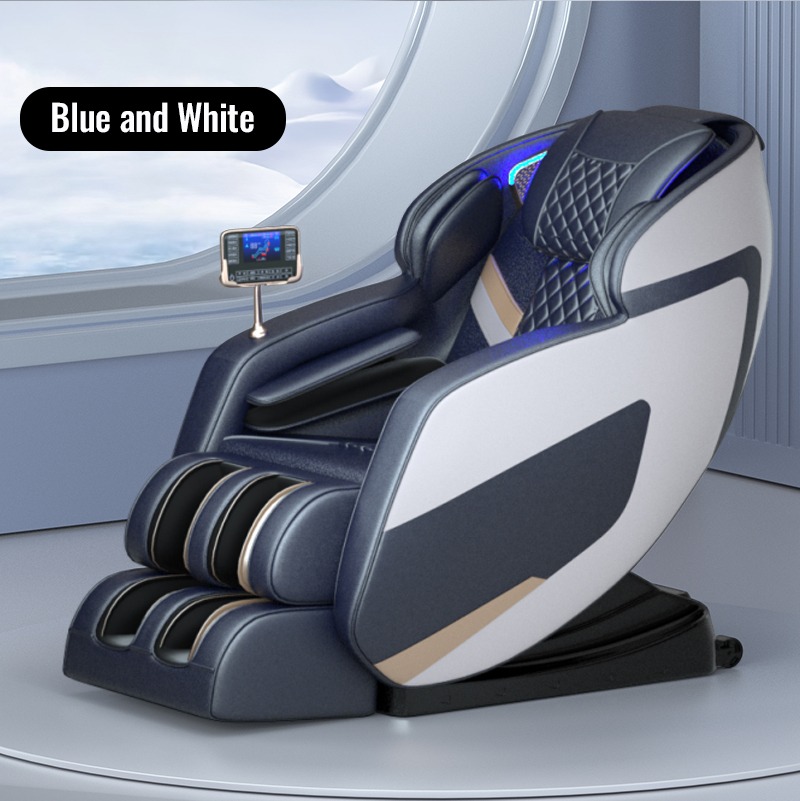
Test the recline, roller depth and airbag fit at our Ghitorni showroom, or book a scheduled Panipat home demo.
What Does “Advanced Full Body” Actually Mean in an Imported Chair?
The phrase is used loosely in the market. A chair with a set of back rollers and two armrests sometimes gets labelled full body or advanced. In practice, a genuine advanced full body chair has to deliver four core systems at the same time: roller coverage from the neck to the glutes, airbag compression across the shoulders, arms, hips, calves and feet, a dedicated lower-limb module with foot rollers, and a reclining posture that unloads the spine while all of this happens.
What makes an imported advanced chair different is the layer on top of those four systems. AI body scanning adjusts the roller path to your shoulder height and spinal curve in real time. Voice control and app integration let you start a program without hunting for the remote. 4D variable rhythm changes speed within a single stroke rather than pressing harder. Independent heat zones let you warm the lumbar area without heating the whole backrest.
Remove any one of the four core systems and the experience is partial. A chair without hip airbags leaves the glutes untouched. A chair with a short track never reaches past the waist. A chair without leg elevation keeps blood pooling in the calves. When you evaluate imported models — especially in a city like Panipat where furniture shops along GT Road and the Sondhapur–Sanoli Road belt are full of loosely labelled "full body" chairs — check each system separately rather than relying on a single feature list.
Panipat buyers tend to be practical and value-conscious, which is an advantage provided you know which spec actually matters. The single most important line on the sheet is not the program count or the brand of the remote; it is the track length. A chair that only kneads the back is a chair that gets used for a month and then parked in a corner of the drawing room. The four-system combination is what makes the chair worth sitting in every evening, year after year.
One more thing worth understanding: "full body" is a claim about coverage, not about intensity. A chair can cover every zone and still feel gentle, or cover half the zones and feel brutal. The advanced imports we stock are designed so coverage and intensity can be adjusted independently — you can run a mild session that still reaches your calves and feet, which is exactly what most people actually want after a shift at the loom or a long day on the road.
Finally, do not confuse "advanced" with "complicated". The best advanced chair in a Panipat household is the one a parent can start with a single button and the one a young couple can customise when they have time. Complexity that nobody uses is not a feature — it is a reason the chair ends up covered with a bedsheet.
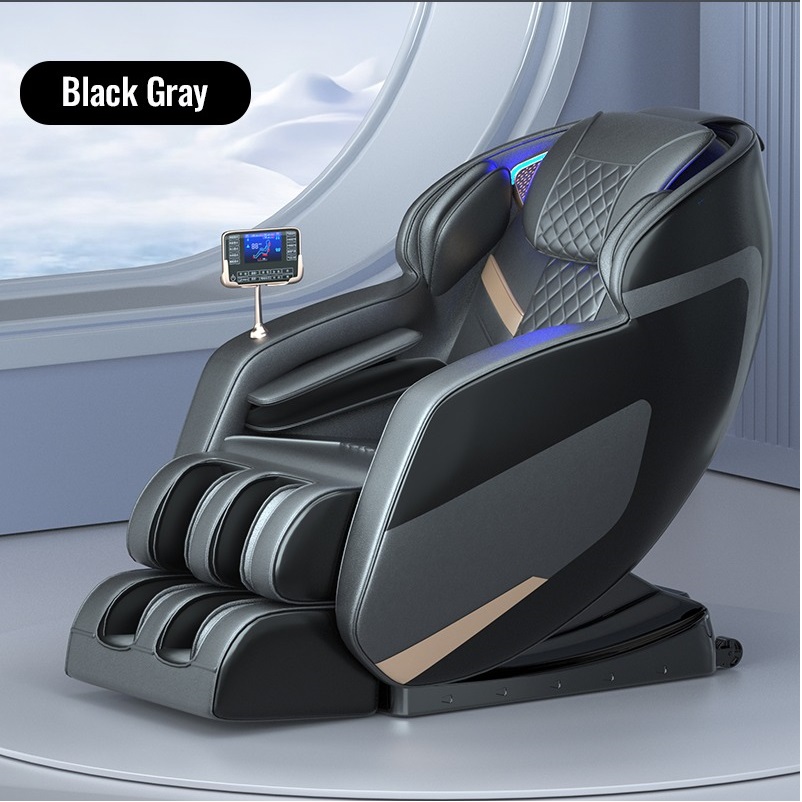
Four core systems of an advanced chair: SL-track, airbag zones, lower-limb module and reclining seat — plus AI, voice and app layers in imported models.
Each body zone is served by a different system — check them one by one during your demo.
The Advanced Coverage Map: Which System Reaches Which Zone
Different parts of the body respond to different massage actions. Rollers knead and press; airbags squeeze and hold; heat relaxes; foot rollers stimulate. A well-designed imported chair allocates the right mechanism to the right zone and layers AI adjustments on top. Use this table during your demo to check each area individually rather than judging the chair on one good sensation in the upper back.
Panipat buyers have a distinctive tension profile shaped by three realities of the city. First, the neck, shoulders and upper back carry the load of handloom and textile work — hours leaning forward over a loom, checking a warp, or standing at a finishing table. Second, the lower back and glutes take the load of the GT Road corridor and NH-44 — long drives, hours in a truck or a taxi, and the stop-start movement of a trading market. Third, the calves and feet take the load of standing on a plant floor at the refinery or thermal station, and of walking the length of a textile unit several times a shift.
The zone most Panipat buyers underestimate is the calves. Standing is harder on the lower legs than most people realise, and the combination of a standing shift and a long drive home leaves a specific heaviness that only calf compression and foot rollers really undo. It is the feature that buyers in the HUDA sectors and the Refinery Township mention first after a week — long before they mention the upper-back features they thought they wanted.
One useful habit during a demo: ask for a program that focuses only on the lower body. It is the fastest way to judge whether the calf airbags inflate evenly and whether the foot rollers reach the arch rather than just the heel. Most buyers never test this, and it is the part of the chair they end up using most.
| Body Zone | What Delivers the Massage | What to Check at the Demo |
|---|---|---|
| Neck & cervical | Upper section of the SL-track | Whether rollers reach the base of the skull without pressing down on the shoulder blades |
| Shoulders & traps | Shoulder airbags plus roller transition | Airbag fit across your shoulder width — too wide and it does nothing, too narrow and it pinches |
| Upper & mid back | Rollers following the thoracic curve | Consistent pressure across the whole span, with no skipping or stuttering |
| Lower back | Rollers plus lumbar heat pad | Heat reach and whether roller depth can be reduced for sensitive days |
| Glutes & hips | Extended SL-track plus hip airbags | Whether the track genuinely extends past the seat rather than stopping at the waist |
| Arms & forearms | Arm airbags | Full wrap along the forearm, not just a squeeze at the wrist |
| Thighs & calves | Calf airbags | Even inflation and no pinching behind the knee joint |
| Feet | Foot rollers plus airbags | Roller speed settings and how much of the sole is covered — arch, not just heel |
2D, 3D and 4D: What Changes Inside the Imported Roller Head
The mechanism determines how the rollers move, and that in turn determines how the massage feels. The label is not marketing decoration — it describes a real difference in mechanical movement. In imported chairs, the difference between a basic 3D and a genuine 4D is usually more pronounced than in locally assembled units, because the imported 4D mechanism uses a dedicated second motor for rhythm variation rather than simulating it through software.
Here is the point most buyers miss: a 4D chair does not simply press harder than a 3D chair. It changes how it moves through a stroke. That variation matters most for people with long-standing tightness in the traps or lower back, because a constant rhythm tends to make those muscles guard rather than release. This is especially relevant for Panipat's textile and industrial workforce — the weavers, loom operators, finishing staff, refinery and thermal plant shift teams, and the traders who spend their days on their feet — whose muscles have learned to stay braced for hours at a time. A constant-rhythm machine only reinforces that pattern. A 4D rhythm interrupts it.
Imported 4D systems from Japan and South Korea often go a step further, using AI to vary the rhythm across a session so the body does not habituate. That is why the same chair can feel different on a Monday evening after a full shift and a Saturday morning after a walk around the Hali Park or a drive out towards Kala Amb — it is adjusting to how your muscles respond, not simply repeating a preset.
For Panipat buyers who work long shifts in the textile units along Sanoli Road and the GT Road industrial belt, who commute daily to Karnal, Sonipat or Delhi, or who drive the NH-44 corridor for a living, the 4D rhythm is often the feature that decides the purchase. A constant kneading machine forces the body to brace against it. A 4D chair that slows, holds and moves on is what the muscles actually respond to after a twelve-hour day.
One practical point for buyers comparing models: ask to feel the same program on a 3D and a 4D chair back to back. Most people can tell the difference within thirty seconds, and the difference is usually larger than the price gap suggests — especially for anyone whose tightness has been building for years rather than weeks. If you cannot feel the difference, save the money and buy a good 3D chair instead. That is a legitimate outcome, and a good importer will tell you so.
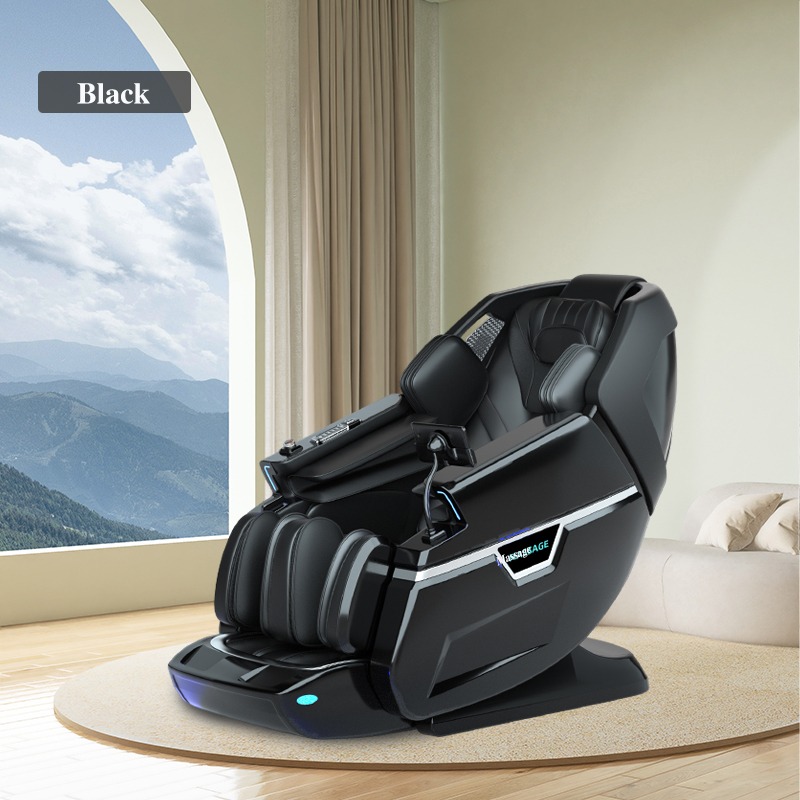
The imported 4D roller head varies speed and rhythm within a single stroke, not just depth.
| Mechanism | Roller Movement | How It Feels in Practice |
|---|---|---|
| 2D | Vertical and horizontal only | Surface kneading at a fixed depth; fine for light relaxation, limited for deep tension |
| 3D | Adds inward and outward depth control | You can dial the rollers deeper into muscle; feels closer to thumb pressure |
| 4D | Adds variable speed and rhythm within each stroke | Rollers slow over a knot, hold briefly, then move on — more like a therapist's hand than a machine |
| 4D + AI | Adds adaptive rhythm that changes across the session | Rollers read your body's response and vary the stroke; imported premium chairs use this system |
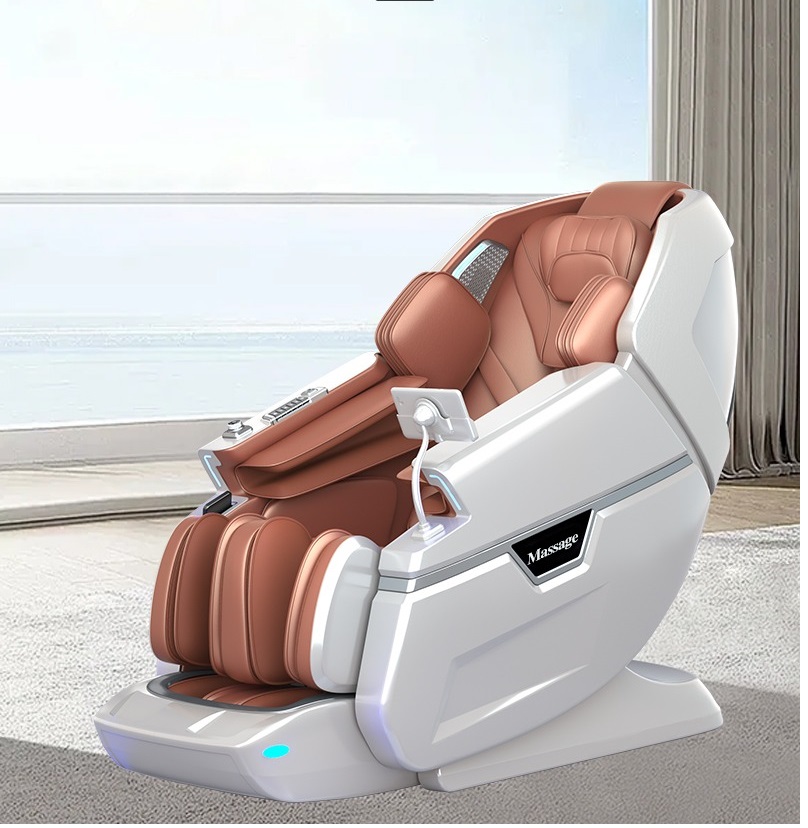
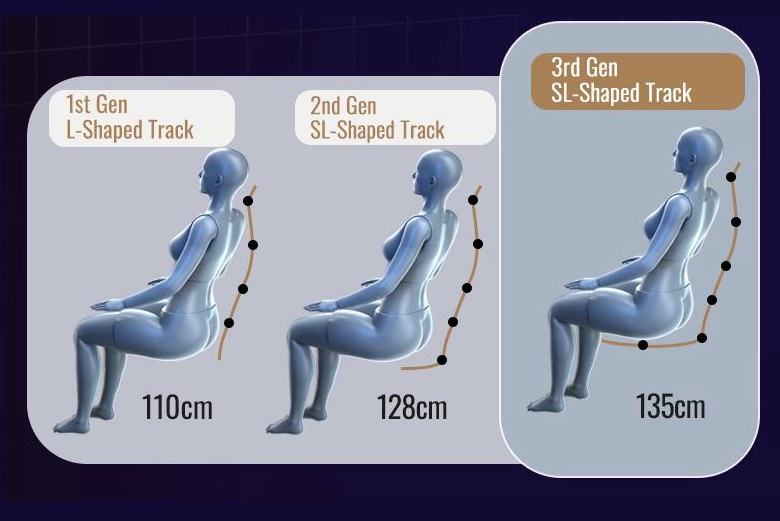
SL-track keeps the spinal S-curve while extending roller reach all the way to the glutes.
Track Geometry: The Specification That Decides Your Coverage
The track is the rail the rollers travel along. It sets the outer boundary of what your chair can physically reach, and no program setting can extend it. This is why track length deserves more attention than almost any other line on the specification sheet — more than the number of programs, more than the colours, more than the brand on the remote.
For a chair that genuinely earns the word advanced, SL-track is the configuration to look for. It gives you the reach of an L-track with the ergonomics of an S-track. In a working city where so many people stand for a full shift and then sit for hours on the GT Road, the glutes and upper hamstrings are almost always tighter than the owner realises. It is the zone almost nobody thinks about, and almost everybody needs.
Imported SL-track systems typically measure 130–145 cm of roller travel, compared with 90–110 cm on entry-level local chairs. That extra 30–40 cm is the difference between a chair that massages your back and a chair that massages your whole posterior chain. It is also the difference between a chair you use as a novelty for a few months and a chair you keep using for years. In Panipat specifically — where the working day often involves both standing and long road time — that extra reach does more work per session than it would for a more sedentary buyer.
When you sit in a demo chair, ask the salesperson to point out exactly where the rollers stop at the bottom of the track. If the rollers stop at the waist, the chair cannot reach the glutes, no matter what the program is called. That single check separates real SL-track from marketing language — and it is exactly the kind of check that a specialist importer will encourage rather than avoid.
A note on room depth: the extended SL-track chairs with the longest reach also tend to need the most recline clearance. In a Panipat drawing room with a deep footprint that is never an issue, but in a first-floor builder flat or an Old City house it can be. That is exactly the trade-off we measure during the demo rather than guess at from a catalogue.
| Track | Coverage | Strength | Trade-off |
|---|---|---|---|
| S-Track | Neck to waist, following the spinal curve | Precise contact along the thoracic and lumbar curve | Stops at the waist — glutes and hamstrings are untouched |
| L-Track | Neck to glutes and upper hamstrings | Long continuous reach down the lower body | Can flatten out along the lumbar curve, reducing support where you need it most |
| SL-Track | Neck to glutes while holding the spinal S-curve | Full length without sacrificing lumbar contour | Premium specification, so it sits in the higher price bands |
| Extended SL-Track | Neck to upper hamstrings with additional hip coverage | Full posterior chain reach; found on imported premium models | Requires more depth when reclined — check your room |
Automatic Body Scanning: Why the Imported Chair Needs to Know Your Height
Rollers only help if they land in the right place. Body scanning uses sensors to locate your shoulder line, spinal curvature and hip position before the massage starts, then adjusts the roller travel to match. Without it, a tall user finds the "neck" program working across the upper back, while a shorter user feels rollers pressing too high. The chair is doing exactly what it was programmed to do — it just does not know where your shoulders are.
This matters more than usual in Panipat households, where a single chair often has to serve a working couple, visiting parents from Karnal or Jind, and sometimes a grandparent who has moved in permanently. Panipat's household is typically large and multi-generational — a joint family structure is still common here, and the drawing room is a shared space rather than a private one. A chair with automatic scanning adapts per user; a chair without it forces everyone into an average body map that fits nobody exactly.
Imported advanced chairs often use dual-sensor scanning — one for shoulder height, one for spinal curvature — and store profiles for multiple users. When you sit down, the chair recognises you and recalls your last program, intensity and recline. That is the level of personalisation an advanced import is supposed to deliver, and it is what makes the difference between a chair that only one person can tolerate and a chair that everyone wants to use.
For Panipat families, this is not a luxury feature. It is the difference between a single purchase that serves the whole household and a single purchase that becomes one person's expensive seat. Multi-user profiles turn the chair into a household appliance rather than a personal one, and in a home where a father works a plant shift, a mother manages the house, and a son or daughter is preparing for competitive exams, that is the calculation that should sit at the centre of the buying decision.
One practical tip: when you test the chair, sit in it exactly as you would at home — not stiffly, and not leaning forward. The scanner reads what you give it. If you sit awkwardly during the demo, the chair will calibrate to an awkward posture, and the massage will feel wrong for reasons that have nothing to do with the machine.
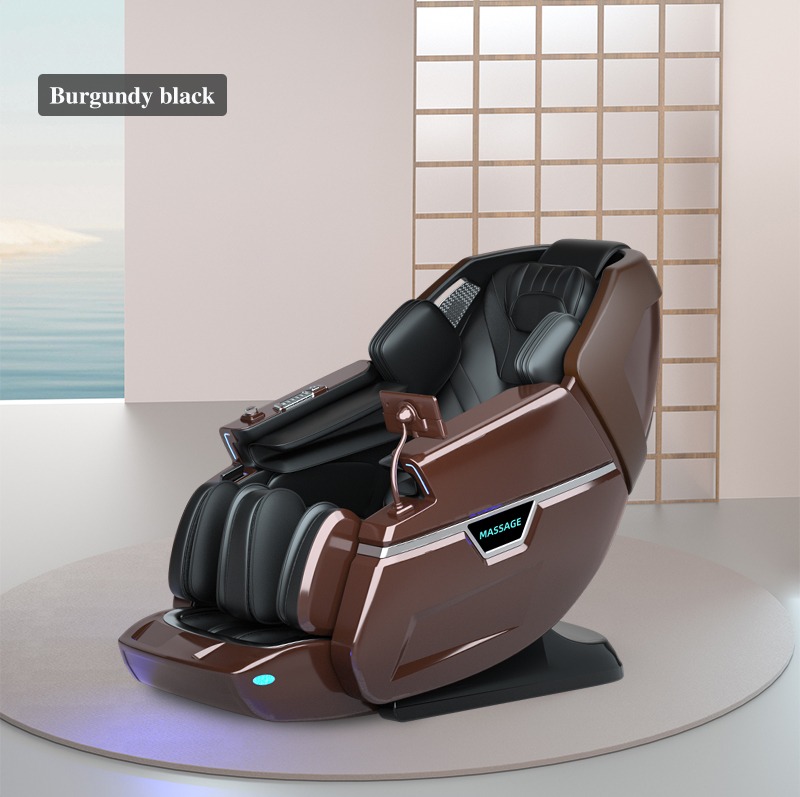
Imported body scanning maps shoulder height and spinal curvature so the rollers land on the right spots for each user.
The Airbag System: Where Rollers Cannot Reach
Airbags handle the areas rollers cannot: the forearms, the outer hips, the calves and the feet. They work by sequential inflation and deflation, which produces a squeeze-and-release rhythm that complements the kneading action of the rollers. Where rollers press and knead, airbags hold and release — and the two together create the circulation that a purely roller-based chair cannot match.
When you compare imported models, look at the number of airbag zones and whether intensity is adjustable. A chair with five intensity levels can be gentle for a parent and firm after a long shift. A chair with a single on/off setting forces everyone into the same pressure. Also check the arm channels — a proper wrap runs the full length of the forearm rather than clamping only at the wrist. In Panipat's builder flats and Old City houses, where the drawing room is often the same room as the dining space, quieter and more adjustable airbag systems make a real daily difference.
Imported premium chairs often include independent left and right airbag control — and in Panipat specifically, this has a real audience. Anyone who carries a bag or a sample folder on the same shoulder every day, anyone who stands with their weight shifted onto one leg at a loom or a counter, and anyone recovering from a single-side strain will find independent L/R control genuinely useful rather than decorative. It is one of those features that sounds like a specification line and turns out to be a daily convenience.
Finally, check the airbag material. Imported chairs typically use multi-layer TPU bladders that hold pressure better and last longer than the single-layer PVC found on cheaper units. That difference shows up after the first year, not in the showroom. In a city with Panipat's dust and agricultural haze — the GT Road corridor, the textile units and the fields around Israna and Madlauda all contribute a fine dust layer through the summer — the material quality of the airbags is one of the better predictors of how the chair will feel three winters from now.
The Lower-Limb Module: Leg Extension, Calf Airbags and Foot Rollers
The leg rest is not an accessory. It carries a large share of the full body experience, and it is the part most often underspecified on cheaper chairs — because it is easy to cut, and hard to notice in a five-minute showroom demonstration. Three things matter.
Extendable length. Taller users need the footrest to extend so the knees stay supported rather than dangling. An undersized footrest puts pressure behind the knee and defeats the purpose. Imported chairs usually offer 15–20 cm of powered extension, which covers most adult heights comfortably. In Panipat households where adults range from 5-foot-2 to 6-foot-3 — common in a joint family — this is not a minor feature. It is the difference between a chair that works for everyone and a chair that works for the tallest person only.
Calf compression. Sequential calf airbags create a pumping action that helps with the heavy-leg feeling that builds up after a long day of standing or driving. This is the single feature most Panipat buyers notice first — especially anyone who works a shift at a loom or on a plant floor, drives NH-44 or the GT Road daily, or commutes to Karnal, Sonipat or Delhi for work. For the weekend walker or the occasional gym-goer in the family, the calf compression is often the first feature they use after a long Saturday.
Foot rollers. A triple-roller foot module covers more of the sole than a single roller plate, and adjustable speed lets you keep it gentle. For anyone who walks or stands a lot, this is often the most-used feature in the entire chair. Imported advanced models add reflexology-style node patterns and toe airbags for a more complete foot session. In Panipat, where a working day at a textile unit can involve a surprising amount of walking between sections, the foot roller module gets far more use than most buyers expect.
Some imported chairs also include a calf-kneading mechanism in addition to airbags — small rollers that work the calf muscles directly. This is worth asking about if your legs feel heavy after long days. In a city where standing work is more common than in the metros, the calf-and-foot module is often the feature that earns the chair its place in the drawing room.
Lumbar Heat Therapy: A Small Feature With an Outsized Effect
Heat changes how the rest of the massage feels. A warmed lumbar pad relaxes the muscles around the lower spine, so the rollers glide rather than catch, and the whole session feels less clinical. In Panipat winters — which swing hard between December and February, with dense fog on the GT Road and NH-44, cold mornings in houses that were built for the summer, and evenings that arrive early — it also makes the chair far more inviting on a cold day when the drawing room has not warmed up. Panipat's independent houses, with their high ceilings and open courtyards, hold the cold longer than a modern apartment does.
Look for independent heat control so you can run warmth without it dominating the session, and be sensible about duration if you have sensitive skin or circulation concerns. Heat is a comfort layer, not a substitute for the mechanical work of the rollers. It does not replace the 4D rhythm or the SL-track coverage — it works with them.
Imported advanced chairs often offer multi-zone heat — lumbar, upper back and sometimes calf — with separate toggles for each. That lets you target the area that actually needs warmth instead of heating the entire backrest. Some models use graphene heating elements that reach temperature faster and distribute heat more evenly than older coil-based pads, which matters in a chair that will be used through the full Panipat winter and then mostly left alone in a summer that regularly crosses 45°C.
In Panipat specifically, heat is a useful test of build quality. A cheap heating pad reaches temperature in five minutes and then plateaus unevenly. A good one warms gradually, holds a consistent temperature across the pad, and shuts off cleanly when the session ends. Ask to feel the heat across the full lumbar pad, not just the centre, during your demo — the difference between a properly designed pad and a cheap one is immediately obvious once you sit in it.
Where Recline Posture Fits Into an Advanced Full Body Session
Posture comes before pressure. In an upright seat, the lumbar discs carry a large share of your upper body weight, and the paraspinal muscles stay switched on simply to hold you up. Reclining redistributes that load across the backrest, seat and leg rest, which lets those muscles relax before the rollers even begin. The chair does its best work when you are not bracing against gravity.
That is why an advanced chair with a good recline feels different from a basic chair without one — the same rollers land on a body that is no longer guarding. Multi-stage recline is worth having: a shallower angle works for watching television, and a deeper angle is better for decompression and unwinding before sleep. In a Panipat drawing room where the chair sits in the same room where the family watches TV or gathers after dinner, being able to run a shallow recline during TV time makes the chair a natural part of the evening rather than a dedicated appointment.
Imported zero-gravity chairs take this further by raising the knees above heart level and tilting the seat back to a specific angle that redistributes body weight across the frame. The effect is closer to a floating position than a recliner. For anyone with lower-back stiffness from long hours at a loom or long drives on NH-44 and the GT Road, the zero-gravity position alone — even before the rollers start — often provides noticeable relief.
Some imported advanced models offer programmable zero-gravity presets and a "memory" button that returns the chair to your favourite angle instantly. If you share the chair — common in Panipat households — this is a small feature that makes a real daily difference. It is also useful if you have a specific recline angle that works around a shoulder strain from repetitive work, or a knee that prefers a particular elevation.
One practical note for independent houses: if the chair is going into a room with a ceiling fan directly overhead, check the recline clearance against the fan's lowest point. It sounds obvious, but it is one of the most common placement issues we see in older Panipat homes where the fan is centred in a smaller room than a modern drawing room would be.
Auto Programs: What They Actually Change
Auto programs are not just preset timers. Each one adjusts roller speed, depth, airbag pressure, heat and recline angle together. A relaxation program uses slower rollers, moderate depth and softer airbags; a recovery program increases depth and calf compression; a stretch program sequences airbag holds with leg extension to open the hips and lower back. Behind each button is a coordinated change across five systems at once.
Twelve to twenty-four programs is a practical range. Fewer than ten starts to feel limiting once the novelty wears off. More than that is fine, but most users will settle on three or four favourites within a month — which is exactly what should happen. The chair is not meant to be explored every session; it is meant to be used.
Imported advanced chairs add two useful layers on top of the basics: AI-recommended programs that select a routine based on your body scan and recent sessions, and custom program saving that lets you store your own combination of intensity, heat and recline for recall. Both features are worth having if the chair will be used daily, because they remove the small friction of reconfiguring the chair every time. In Panipat, where the working day often starts early and ends late, that reduction in friction is exactly the point.
Some chairs also include targeted programs for specific concerns — "office worker," "athlete recovery," "senior gentle," "pre-sleep" — which are essentially curated versions of the manual settings. They are convenient shortcuts, not fundamentally different mechanisms, but they make the chair easier to use for family members who do not want to fiddle with settings. In a Panipat joint family where the chair may be used by a father who works a plant shift, a mother who manages the house, and a grandparent in the same week, that simplicity is the whole point. The best program is the one someone actually presses without asking for help.
One small suggestion: set one button — the simplest relaxation program at low intensity — as the default that anyone can press. Leave the customised programs for the person who enjoys configuring them. That way the chair never becomes "someone's machine" that the rest of the family avoids because they are not sure which button to press.
Stretch Programs: The Underrated Half of the Chair
Most people buy a massage chair thinking about kneading, then end up using the stretch program most often. During a stretch sequence, the airbags hold the hips and shoulders in place while the leg rest and backrest move apart, creating a controlled lengthening of the lower back and hip flexors. It is the part of the chair that does something a manual massage cannot easily replicate.
For anyone who sits at a desk all day — or spends hours in a car — the hip flexors shorten and pull the pelvis forward, which is a common contributor to lower back discomfort. A few minutes of stretch work in the evening addresses that in a way that pure roller massage cannot. In Panipat, where the textile workforce spends hours leaning forward at a loom and the trading community spends hours on its feet or in a vehicle, the hip flexors are almost universally shortened by mid-week. It is one of those problems that builds so gradually that people assume it is simply "how their back is" — until they feel what a decompressed lower back actually feels like.
Imported advanced chairs often offer more aggressive stretch programs with motorised leg extension and shoulder anchoring. Some include a "spinal decompression" mode that gently traction the lower back by moving the seat and backrest in opposite directions while the airbags hold you in place. That is the kind of feature that distinguishes an advanced import from a mid-range local chair — and it is the feature that many buyers do not fully appreciate until they have used it for a few weeks.
For Panipat buyers who commute to Karnal, Sonipat or Delhi for work, or who spend long hours at a loom or behind a counter, the stretch program is often the feature that surprises them most in a demo. They come in expecting a back massage and leave understanding that decompression is the bigger benefit. It is worth asking for a demo of the stretch program specifically, not just the default relaxation mode.
Will an Advanced Chair Fit in a Panipat Home?
This is the question we hear most, and it is the right one to ask first. Panipat's housing is very different from the metro cities, and each type raises its own space questions. Model Town has wide plots and generous drawing rooms, but the furniture is often already placed along the walls and the room has a fixed layout. The HUDA sectors from Sector 1 to Sector 25 have standardised plots and cleaner floor plans, but many are first-floor builder flats with a single staircase and a compact living room. The Old City — around Insar Bazar, Battal Bazar and the Devi Mandir belt — has tall, narrow houses where the room is small but the ceiling is high. And the Refinery Township and Thermal Colony have quarter layouts that are efficient but standardised, so the available wall run is predictable.
Most reclining massage chairs require roughly 170–190 cm of depth from the wall when fully reclined, though space-saving designs cut that requirement significantly by sliding the seat forward as the backrest tilts. In an Old City house or a first-floor builder flat, the difference between a 170 cm and a 190 cm recline can be the difference between a usable chair and a chair that blocks the passage to the kitchen. In a Model Town drawing room, the difference is more likely to be aesthetic than functional.
Rather than guessing from a dimension chart, we measure your intended spot during the home demo and demonstrate the full recline in that exact position. If the room is tight, we shortlist compact imported models or suggest an alternative corner. If the room is generous but already furnished, we suggest placements that let the chair sit as a considered piece — often against a natural wall, near a corner, or in a bedroom rather than the main drawing room. This single step prevents most of the regret that follows an online-only purchase — and it is the step that most online listings simply cannot offer.
In Panipat specifically, four additional factors come up often. First, in Old City houses the internal doorway between rooms can be narrower than a modern build, which affects how the chair is delivered even if the room itself is large enough. Second, in first-floor builder flats the staircase is often the limiting factor, not the room — we check the staircase before we check the floor plan. Third, in township quarters, the drawing room often doubles as the dining room, so the chair has to leave a clear walking path. Fourth, in Model Town houses with a verandah or a courtyard, an outside-facing room can be an excellent spot — but it needs protection from dust and direct sun.
Getting the Chair Into Your Panipat Home: Staircases, Landings and Turn Radius
This is where Panipat differs most from a high-rise city. There is almost no service-lift dependency here — the delivery is won or lost on the staircase. A massage chair arrives in a large, heavy crate, and in a Panipat builder floor that crate has to go up a stairwell that was designed for furniture and people, not for a two-metre box. Before dispatch we confirm four measurements: the staircase width, the landing turn radius, the main door width, and the number of floors. If the staircase will not take the crate, we plan a balcony hoist or a window entry, or we unpack and carry the chair in pieces.
On most imported models the backrest, seat and leg rest separate, which is exactly what makes an upstairs delivery possible in a narrow stairwell. We use that to our advantage in Panipat more often than in any other city we serve. In older houses around Insar Bazar and Battal Bazar, a full-crate carry is simply not realistic, and we plan for a two-person piece-by-piece carry from the moment we quote.
Panipat-specific logistics: in the Refinery Township and Thermal Colony, we coordinate the gate entry and the visitor protocol in advance, because those townships have their own security desks and delivery windows. In Model Town and the HUDA sectors, we confirm whether the house has a side gate or a rear access that makes the carry shorter. In the villages around Israna, Madlauda, Bapoli and Sanoli, we confirm the approach road and the gate width before the day, because a narrow village lane can stop a delivery van a hundred metres short of the house.
One more Panipat consideration: traffic on NH-44 and the GT Road can add 30–90 minutes to a delivery slot, especially during the harvest season when agricultural traffic shares the road, and during the winter fog when visibility on the highway drops sharply. We schedule Panipat deliveries mid-morning where possible, keep you updated on the day, and build in enough buffer that a highway delay does not turn into a wasted afternoon for you. If your home has a fixed delivery window, tell us in advance and we will build the slot around it.
Power, Stabilisers and Panipat Voltage Fluctuation
An advanced massage chair runs on a standard domestic socket, but the electronics are sensitive to voltage swings. Panipat's supply is generally workable in the main city, but the pattern here is different from a metro: residential lines often share load with textile units, agricultural feeders and small industrial connections, and the summer demand in a city that regularly crosses 45°C is heavy. Voltage dips are more common than in a dedicated residential township, and they are exactly what damages a control board.
Many imported manufacturers recommend a 1000 VA stabiliser, and we recommend it too — in Panipat more strongly than in most cities. A control board replacement costs far more than the stabiliser, and it is the single most common avoidable failure we see in imported chairs across the GT Road belt. If you are buying a premium imported model, protecting it with a stabiliser is not an upsell; it is basic ownership.
Check that the socket you plan to use is earthed and that the chair is not sharing a circuit with a heavy appliance. If your home has an inverter or UPS backup, confirm the chair's load is within its capacity before assuming it will run during a power cut. Imported chairs typically draw 100–200W during operation, well within most home inverter capacities, but the startup surge from the air pump should be considered — especially in a house where the inverter is already carrying fans, lights and a water pump.
For older Panipat houses with mixed wiring — common in the Old City and in some Model Town properties that have been extended over the years — we recommend having an electrician check the earthing at the intended socket before delivery. It is a fifteen-minute check that prevents a whole class of nuisance issues later. In newer builder flats and township quarters the earthing is usually fine, but the check costs little and confirms it.
Voltage fluctuation, not power draw, is what damages these machines. In a city where supply quality is uneven across neighbourhoods, the stabiliser is the difference between a chair that lasts ten years and one that needs a control board replacement in year three. This is the one accessory we recommend unconditionally, regardless of which part of Panipat you live in.
Upholstery and Build: What Survives a Panipat Year
Panipat is a hard climate for upholstery. Summers are long and dusty, with temperatures that regularly cross 45°C; the monsoon is humid; and the winter brings dense fog and a sharp cold. Add the dust from the textile units, the GT Road traffic and the agricultural belt around the city, and you have a cycle that punishes fabric far more than it punishes leather-look materials. Breathable synthetic leather handles that cycle well: it wipes clean, resists moisture and does not hold dust the way fabric does. Premium fabric feels softer but needs more attention and is harder to keep dust-free through the summer months.
During your demo, press into the seat and backrest to judge foam density, and listen for creaks when the chair is fully reclined. A well-built chair stays rigid under load. Airbags should inflate smoothly and evenly, and the rollers should travel without jerking or stalling at any point along the track. In a Panipat drawing room where the chair often doubles as a family seat, these small tests of build quality matter more than they do in a showroom.
Imported advanced chairs often use denser cold-cure foam that holds its shape longer than the softer foam on budget units. That difference becomes noticeable after the first year — the imported chair still feels firm where the cheaper chair has started to sag. Ask about foam density during your demo; it is one of the better proxies for long-term build quality, and it is something a specialist importer will happily explain.
For buyers in the GT Road and NH-44 belts, and in houses near the textile units, the dust exposure is worth thinking about. A chair placed away from a road-facing window or an open courtyard door lasts noticeably longer than one placed directly in the dust path. In a Model Town house with a verandah, a chair in an inner room will always outlast one in the verandah, even though the verandah looks like the more natural spot on a winter afternoon.
How Loud Is an Advanced Massage Chair in a Panipat Home?
Louder than most buyers expect from the showroom, quieter than they fear. The dominant sounds are the air pump cycling and the roller motor under load — roughly comparable to a quiet conversation. In a large Model Town drawing room this is unremarkable; in an Old City house where the drawing room opens directly onto a bedroom corridor, or in a township quarter where the walls are shared, an evening session can carry further than you might expect.
Ask to hear the chair with the airbags running at maximum, not just the rollers at low speed. That is the loudest the machine will ever be, and it is the honest test. A showroom demo that only runs the rollers at low speed is not giving you the full picture.
Imported advanced chairs typically use brushless motors and dampened air pumps, which run noticeably quieter than the brushed motors on cheaper units. Some premium models also include a "quiet mode" that reduces airbag pump speed at the cost of slower inflation. If your chair will sit in a shared living space — common in Panipat households where the drawing room and the bedroom share a wall, or where a joint family uses the same room through the evening — this is worth checking during the demo.
One practical tip: if the chair will sit near a bedroom wall or on an upper floor above a ground-floor room, place a small rug or a piece of underlay beneath it to absorb motor vibration. In older Panipat houses with tiled floors and solid masonry walls, vibration travels further than people expect, and a simple rug makes an evening session far less disruptive.
What Regular Advanced Sessions Can Realistically Do For You
Unload the lower back
Sitting and standing both compress the lumbar region, and in a working city the day usually contains a lot of both. A reclined session takes that load off, and the roller work then has a chance to loosen tissue that would otherwise stay guarded. Most users describe it as putting down a weight they did not realise they were carrying. For Panipat buyers who spend hours at a loom, behind a counter, or on the GT Road corridor, this is the benefit that shows up fastest.
Ease upper-back and shoulder tightness
Leaning forward over a loom, checking a warp, or working at a finishing table rounds the shoulders forward and tightens the chest. Track coverage that reaches the cervical and thoracic region, combined with shoulder airbags, works on the muscles that pull the upper back out of alignment. The chair cannot strengthen anything, but it can reduce the tightness that keeps you stuck in a bad position. For Panipat's large textile, refinery and trading population, this is often the difference between a manageable week and a painful one.
Reduce the heavy-leg feeling
Elevation plus sequential calf compression encourages blood to return from the lower legs. If you stand or drive for a living, this is often the benefit people notice fastest — usually within the first week. Panipat's long standing shifts and the GT Road commute make this a particularly popular reason for buying. It is also the benefit that the walker and the occasional gym-goer in the family ends up using most often.
Restore a little range before the next day
This is the benefit that does not get mentioned in brochures. The chair cannot make you fitter, but it can stop a working week from compounding. A short session on Tuesday evening often matters more than a long one on Sunday, because it interrupts the accumulation rather than letting it build for six days. For anyone in a repetitive job — and Panipat has a great many of them — that interruption is the whole point.
Stress, Sleep and the Evening Ritual
A supported recline with gentle pressure tends to shift the nervous system out of its alert state. That is why so many users feel drowsy fifteen minutes into a session. It is not a sedative effect — it is simply the body stopping the work of holding itself upright. Once that work stops, the body takes the opportunity to unwind.
For people in demanding roles — and Panipat has a lot of them between textile unit owners managing export deadlines, refinery and thermal plant shift teams, traders dealing with daily price movements, and households where the working day starts before sunrise — a 15-minute session before bed can become the marker that separates the working day from the rest of the evening. It does not fix sleep hygiene on its own, but it removes one common obstacle: physical tension that will not switch off.
Imported advanced chairs with a dedicated "pre-sleep" program sequence gentle rollers, low heat and a deeper recline to support this wind-down. Some include breathing-pace guidance through subtle airbag rhythm. These are small touches, but they make the chair easier to use as a habit rather than a novelty. The chair becomes something you look forward to, not something you have to remember to use.
One thing worth saying plainly: a massage chair is not a cure for stress, and it is not a substitute for sleep. It is a fifteen-minute reset. But in a household where the evening is shared and the television is on and the phone keeps buzzing, fifteen minutes of enforced stillness in a reclined position does more than most people expect. Many of our customers describe it as the only part of the day when nobody can ask them to do anything.
Recovery After Work, Travel and Long Weeks
Recovery in Panipat is less about sport and more about the working week. A shift at a loom, a day on a plant floor, a long drive on NH-44, or a week of loading and unloading in a trading market all leave the same signature: tight calves, a compressed lower back and guarded shoulders. Recovery is usually the part that gets skipped, and Monday morning tells the story.
The same applies after a long drive or a train journey. Panipat Junction is a major stop on the Delhi–Karnal line, and plenty of residents commute or travel for work. A gentle program with leg elevation and calf compression is not a substitute for moving around, but it shortens the time it takes to feel normal again. For residents who drive to Chandigarh, Delhi, Jaipur or Dehradun over a weekend via NH-44 and the KMP Expressway, the recovery session on Sunday evening has become a familiar routine for many of our customers.
Imported advanced chairs with dedicated recovery programs sequence calf compression, hip airbag holds and gentle lumbar work in a way that feels more purposeful than simply running a general relaxation routine. If you have a physically demanding job in a textile unit, a factory, a warehouse or on the road, ask for a demo of the recovery program specifically — it is often more convincing than the default relaxation mode.
One honest caveat: recovery programs are the most intense programs on the chair, and they are not meant for daily use if your body is not used to them. Start on the gentle side for the first two weeks, then step up. A chair that leaves you sore is a chair you will stop using.
Who Gets the Most Out of an Advanced Chair in Panipat?
Textile, Handloom & Weaving Workforce
Hours at a loom, a finishing table or a quality-check station tighten the neck, shoulders and upper back while the legs take the load of standing. The stretch program, shoulder airbags and calf compression are the features this group uses most. It is the single largest buyer segment we serve in Panipat, and the one that benefits most visibly from a proper SL-track chair.
Refinery, Thermal Plant & Industrial Shift Teams
Shift work at the Panipat Refinery, the thermal power station and the industrial units around the city produces irregular sleep and long standing stretches. The recovery program, independent heat control and multi-user profiles matter most here — especially in households where two people work different shift patterns.
GT Road Traders, Transporters & Commuters
Daily movement along NH-44 and the GT Road corridor compresses the lower back and tires the legs. Calf compression and the zero-gravity recline matter more than raw intensity for this group. It is also the reason buyers who drive for a living tend to choose chairs with stronger lower-limb modules.
Joint Families & Multi-Generational Households
Panipat's households are often large and shared, with grandparents, parents and children in the same home. Multi-user profiles, gentle heat and low-intensity airbags make a single chair usable by everyone. Consult a doctor first if there are medical concerns.
Entry, Mid-Range and Premium Imported Chairs: What Actually Changes
Price tiers are not just about brand names. They map to real mechanical differences. Here is what typically separates the three bands of imported advanced chairs we supply in Panipat.
| Feature | Entry Import | Mid-Range Import | Premium Import |
|---|---|---|---|
| Mechanism | 2D or basic 3D | 3D with depth control | Genuine 4D with variable rhythm and AI adaptation |
| Track | S-track | L-track or short SL-track | Full extended SL-track |
| Body scanning | Basic or none | Automatic shoulder detection | Dual-sensor shoulder and spinal mapping with user profiles |
| Airbag zones | 3–4 zones | 5–6 zones | 7+ zones with independent left/right and intensity levels |
| Recline | Fixed or single stage | Two stages | Three customisable stages plus zero-gravity presets |
| Foot module | Vibration only | Single roller | Triple rollers with speed control and toe airbags |
| Heat | Often absent | Lumbar heat | Multi-zone heat with independent toggles |
| Controls | Basic remote | Touchscreen or remote | Touchscreen plus voice and app control |
For most Panipat buyers, the mid-range import is the value point — it gives you a real SL-track, genuine depth control and a working foot module without paying for AI features you may never use. The premium tier makes sense if the chair will be used daily by more than one person, or if you specifically want the 4D rhythm and multi-user profiles.
Typical Specifications of the Advanced Chairs We Import
Exact specifications vary by model. The ranges below describe the class of advanced imported chairs available through LVS Massager in Panipat.
| Feature | Typical Range |
|---|---|
| Massage mechanism | Genuine 4D with AI rhythm adaptation |
| Track | Extended SL-track, approximately 130–145 cm of roller travel |
| Recline stages | 2–3 motorised stages plus zero-gravity presets |
| Body scanning | Dual-sensor automatic shoulder and spinal mapping with multi-user profiles |
| Airbag coverage | Shoulders, arms, hips, calves and feet with independent left/right control |
| Heat therapy | Multi-zone: lumbar, upper back and calf (varies by model) |
| Foot module | Triple reflexology rollers with adjustable intensity and toe airbags |
| Auto programs | 12–24 presets with AI recommendations and custom program saving |
| Controls | Touchscreen, voice control and app integration |
| Upholstery | Breathable synthetic leather or premium fabric |
| Voltage compatibility | 220–240V, 50Hz — checked for Indian supply |
| Recommended stabiliser | 1000 VA |
| Origin | Japan, South Korea, China or Vietnam — varies by model |
Buying From a Specialist Importer vs. Buying From an Online Listing
An online listing can show you a photograph and a specification table. It cannot tell you whether the rollers will reach your neck, whether the airbags will fit your shoulders, or whether the crate will clear your staircase landing in a first-floor builder flat. Those three questions decide whether you end up using the chair every day or parking it in a corner.
Buying from an importer adds another layer: you are dealing with someone who has handled customs clearance, checked the model for Indian voltage and BIS-relevant compliance, and can source spare parts. That is not the same as buying a grey-market unit that arrives without local support — and in a city like Panipat, where imported goods often move through informal channels and the nearest authorised service centre can be in Delhi or Chandigarh, the difference is worth paying attention to.
| Factor | LVS Massager (Specialist Importer) | Online-Only Listing |
|---|---|---|
| Try before buying | ✔ Showroom visit and scheduled home demo | ✘ Usually not possible |
| Fit assessment | ✔ Measured in your actual room | ✘ Based on listed dimensions |
| Staircase check | ✔ Confirmed before dispatch | ✘ Not considered |
| Compliance checked | ✔ Voltage, certification and spare-part planning | ✘ Often unclear or grey market |
| Delivery into the home | ✔ Planned around staircases, gates and floors | Varies; often kerbside |
| Installation | ✔ Professional setup and functional check | Often self-assembly |
| Warranty coordination | ✔ Handled by the importer | Call-centre dependent; may not cover imports |
| Spare parts access | ✔ Sourced through the import channel | ✘ Often unavailable |
| Ongoing relationship | ✔ Same team for years | Transactional |
The Home Demo: What Happens During the Visit
We bring the chair to you, on scheduled Panipat demo trips. Because the city is roughly 2.5–3 hours from our showroom, we plan demos in cluster visits rather than same-day callouts — so the appointment is confirmed in advance and the slot is protected. The visit typically runs like this: we identify the intended position, measure the wall clearance, check the staircase and door widths, and demonstrate the full recline in that exact spot. Then you sit in the chair, cycle through the programs, and adjust the intensity until it suits you. The whole visit usually takes 45–60 minutes.
Family members are encouraged to try it too — if a chair will be shared, the shortest and tallest users in the house should both test the footrest extension and shoulder airbag fit. There is no obligation to buy; the point of the visit is to replace guesswork with experience. In Panipat joint families, it is worth checking that a grandparent is comfortable with the controls rather than only the primary buyer.
For imported advanced chairs, the demo also covers the features that are harder to judge from a brochure: AI body scanning in action, the voice control response, the app interface, and how the 4D rhythm differs from the 3D model. These are the features you are paying extra for, and they should be tested in person. If a seller cannot demo these features in your home, they are not the right seller for you.
We cover Panipat city and the surrounding district — Model Town, Old City, Sondhapur, Tehsil Camp, Insar Bazar, Battal Bazar, Devi Mandir, Kabul Bagh, Hali Park, Curzon Road, GT Road, NH-44, Sector 1 to Sector 25, Babail, Siwah, Chulkana, Naultha, Shera, Urlana, Bapauli, Israna, Madlauda, Sanoli, Sanoli Road, Samalkha, Gharaunda, Assandh, Taraori, Nilokheri, Panipat Refinery Township and Thermal Colony. We also cover Karnal, Sonipat, Safidon and Jind by appointment.
For the Refinery Township, Thermal Colony and gated societies, we coordinate the gate entry in advance so the demo team is not held up at the security desk. If your home has no easy visitor parking, tell us in advance and we will plan accordingly. And if travelling to Delhi is easier for you, our Ghitorni showroom is open seven days a week — many Panipat customers combine a Delhi trip with a showroom visit and skip the home demo entirely.
Delivery and Installation Across Panipat
On delivery day, our team brings the chair in, positions it where you want it, levels it, and runs a complete functional check across every program before handing over. We then walk you through the remote or touchscreen, set up a starting program, and explain the stabiliser requirement. The whole handover takes about 30–45 minutes.
We schedule deliveries by slot so you are not waiting through an entire day. Because Panipat deliveries involve a long approach run, we confirm the date and the window a day in advance and keep you updated on the road. Traffic on NH-44 and the GT Road, the winter fog, and the harvest-season agricultural traffic can all add time, and we build that into the schedule rather than pretending it does not exist.
For imported chairs, installation includes a short walkthrough of the app setup and voice-control pairing, plus a demonstration of how to update the chair's firmware if the model supports it. These are the small things that make the advanced features usable from day one rather than something you discover months later. If the chair is being set up for multiple users, we also take the time to configure each profile.
If the chair is going to a first or second floor and the staircase is tight, we arrive with the chair partially disassembled and reassemble it in the room. That is standard practice for us in Panipat rather than an exception. It saves you the risk of a staircase carry that damages both the chair and the stairwell, and it is the reason we ask for staircase measurements before we confirm a delivery date.
Import Warranty, Service Requests and Annual Maintenance
Warranty on imported massage chairs in India generally runs from one to two years against manufacturing defects, with some premium models extending coverage on motors and frames. What matters more than the headline number is how a claim actually gets handled when the manufacturer is overseas.
As the importer, we are your point of contact for warranty coordination. We explain exactly what your chosen model covers and what it does not, help you raise service requests, and coordinate with the manufacturer's service partner. If a part needs to be imported, we handle the sourcing and timeline so you are not left chasing an overseas call centre. In Panipat, where the nearest brand service centres are in Delhi, Chandigarh or Karnal, having an importer who handles the coordination makes a real difference in response time.
Where an Annual Maintenance Contract is available, we will tell you whether it is worth the cost for your usage pattern — and where it is not. For most daily users, a basic AMC covering two inspections a year is worthwhile; for occasional users, pay-per-service is usually more economical. We do not push AMCs on buyers who do not need them.
One practical note for Panipat buyers: keep the invoice and warranty card in a safe place, and photograph them on the day of delivery. Imported chairs sometimes require the original import documentation for warranty claims, and in a house where papers move between almirahs and files, that scanned copy on your phone is often the thing that saves a week of delay.
Our Panipat Service Area
Our showroom is at Ghitorni on M.G. Road in South Delhi, roughly 2.5–3 hours from Panipat via NH-44 and the GT Karnal Road, or a slightly longer but smoother run using the KMP Expressway and the Eastern Peripheral. From there we deliver, install and support customers across Panipat district and the surrounding GT Road belt.
| Zone | Key Localities We Serve | Demo & Delivery |
|---|---|---|
| Panipat City Core | Model Town, Old City, Sondhapur, Tehsil Camp, Insar Bazar, Battal Bazar, Devi Mandir, Kabul Bagh, Hali Park, Curzon Road, Panipat Junction | ✔ Scheduled demo |
| HUDA Sectors & Builder Flats | Sector 1, 6, 7, 8, 11, 12, 13, 14, 15, 16, 17, 18, 19, 20, 21, 22, 23, 24, 25, HUDA residential belts | ✔ Scheduled demo |
| GT Road, NH-44 & Highway Belt | GT Road properties, NH-44 corridor, Babail, Siwah, Chulkana, Naultha, Shera, Urlana | ✔ Scheduled delivery |
| Township & Institutional | Panipat Refinery Township, Thermal Colony, Indian Oil Panipat Refinery area, Panipat Thermal Power Station area, PIET and Geeta University belt | ✔ By appointment |
| Rural & Outer Panipat District | Bapauli, Israna, Madlauda, Sanoli, Sanoli Road, Samalkha, Gharaunda, Assandh | ✔ By appointment |
| Neighbouring Districts | Karnal, Taraori, Nilokheri, Sonipat, Safidon, Jind, Kaithal | ✔ By appointment |
Not sure whether your locality is covered? Send us your locality or pin code on WhatsApp and we will confirm the next available demo slot.
Frequently Asked Questions
What does it mean to buy an imported advanced massage chair in Panipat?
An imported advanced massage chair is manufactured outside India — typically in Japan, South Korea, China or Vietnam — and brought into the country by a licensed importer. You get the current generation of roller mechanisms, AI body scanning, voice control and app integration that global brands release first. The importer handles customs clearance, BIS-relevant compliance, voltage compatibility, warranty handling and local after-sales support for Panipat, Karnal, Sonipat and the surrounding GT Road belt.
What makes a massage chair a genuine advanced full body massage chair?
A genuine advanced full body massage chair combines four systems that work together: a long SL-track that runs from the neck to the glutes and upper hamstrings, multi-zone airbag compression covering shoulders, arms, hips, calves and feet, a lower-limb module with foot rollers, and a reclining seat that distributes body weight. Advanced imported models add AI body scanning, voice control, app integration, 4D variable rhythm and independent heat zones on top of these four systems.
Do you deliver and install in Panipat builder floors, HUDA sectors and the Refinery Township?
Yes. We handle Model Town, Old City, Sondhapur, Tehsil Camp, Insar Bazar, Battal Bazar, Devi Mandir and Kabul Bagh, the HUDA sectors from Sector 1 to Sector 25, GT Road and NH-44 properties, Samalkha, Gharaunda, Assandh, Madlauda, Israna, Sanoli Road, Panipat Refinery Township and Thermal Colony. Panipat's housing is mostly independent houses and builder floors rather than high-rises, so staircase width, landing turn radius and first-floor access matter more than service lifts. We confirm all three before dispatch, position the chair, run a full functional check and explain the controls before leaving.
Can an advanced massage chair fit inside a Panipat home or builder floor?
In most cases yes, provided the model is chosen correctly. Panipat homes in Model Town and the HUDA sectors often have generous drawing rooms, while Old City houses and some builder floors have narrower passages but taller rooms. Compact and space-saving imported designs need less depth than a fully reclining lounger. During the home demo we measure the actual wall clearance in your room and demonstrate the recline in that exact spot, which is far more reliable than working from a specification sheet.
What is the practical difference between a 3D and a 4D mechanism in imported chairs?
A 3D mechanism moves the rollers up and down, side to side, and in and out, so you can control depth. A 4D mechanism adds variable speed and rhythm within a single stroke, meaning the rollers can slow over a tight spot, dwell briefly and then move on. Imported 4D chairs from Japan and Korea refine this further with AI that adapts rhythm to your body's response. For users with specific knots and long-standing stiffness — common among Panipat's handloom and textile workforce, refinery and thermal plant shift teams, and GT Road traders — the 4D variation usually feels closer to a therapist's hand.
Which Panipat localities do you cover for home demo?
We cover Panipat city and the surrounding district belt — Model Town, Old City, Sondhapur, Tehsil Camp, Insar Bazar, Battal Bazar, Devi Mandir, Kabul Bagh, Hali Park, Curzon Road, GT Road, NH-44, Sector 1 to Sector 25, Babail, Siwah, Chulkana, Naultha, Shera, Urlana, Bapauli, Israna, Madlauda, Sanoli, Sanoli Road, Samalkha, Gharaunda, Assandh, Taraori, Nilokheri, Panipat Refinery Township and Thermal Colony. We also cover Karnal, Sonipat, Safidon and Jind by appointment. Send us your locality or pin code on WhatsApp and we will confirm the next available demo slot.
Are imported massage chairs certified for use in India?
Quality importers source chairs that meet BIS guidelines where applicable, carry CE or equivalent international safety marks, and are wired for 220–240V Indian supply. We walk you through the certification documents for the specific model, confirm voltage compatibility, and recommend a 1000 VA stabiliser to protect the electronics from local supply fluctuations — particularly relevant in parts of Panipat where agricultural feeders, textile units and residential lines share the load, and where summer demand is heavy.
What warranty and service support do you provide in Panipat?
Warranty varies by model. Most imported chairs carry a 1 to 2 year warranty against manufacturing defects, and some premium models extend coverage on motors and frames. As the importer, we handle warranty coordination directly, help you raise service requests, and arrange spare part sourcing so you are not left handling an overseas call centre alone.
Do you offer a free home demo in Panipat?
Yes. Because Panipat is roughly 2.5 to 3 hours from our showroom, we schedule demos in cluster trips rather than same-day callouts. Book an appointment and we will confirm the next available Panipat slot, or visit our Ghitorni showroom if you are travelling to Delhi. Either way, you can test the recline, compare roller depth and confirm that the chair fits your room before committing.
Is an advanced massage chair safe if I have a medical condition?
Massage chairs are generally safe for healthy adults, but they are not suitable for everyone. Consult a doctor before use if you are pregnant, use a pacemaker or implanted electronic device, have osteoporosis, a recent fracture, a history of blood clots, or a diagnosed spinal condition. During your demo, tell us about any condition so we can show you which programs and intensities to use and which to avoid.
A Simple Framework for Choosing Your Imported Chair
There is no universally best chair. There is only the chair that suits your body, your room and the way you will actually use it. Work through these six questions in order.
- Where is the tension? Neck, shoulders and upper back point you toward strong upper-track coverage and shoulder airbags — the classic textile-work profile. Lower back and legs point you toward an extended SL-track and a serious calf module — the classic long-drive profile. If you work a standing shift or drive NH-44 daily, the lower-back-and-legs priority is almost always the right one.
- Who else will use it? Two working adults of different heights make automatic body scanning with user profiles close to essential. A single user can compromise on it. In a Panipat joint family, assume it will be shared across three generations.
- Which floor is it going on? In Panipat this question comes before the room measurement. A beautiful chair that cannot clear your staircase is not a purchase, it is a return. Confirm the staircase width and the landing turn before you shortlist.
- How much floor space do you have? Measure the wall clearance next. Space-saving designs exist for a reason, and in an Old City house or a compact builder flat they matter far more than in a Model Town drawing room.
- What is your power situation? A stabiliser is cheap insurance, and the chair should be on an earthed circuit that is not shared with heavy appliances — this matters more in Panipat than in most cities because of mixed feeders and heavy summer load.
- Who will service it? Confirm that support exists through the importer before you pay, not after something goes wrong. In Panipat, an importer who plans deliveries and handles warranty coordination is worth more than a marginally better model from a seller who cannot reach you.
Six Mistakes Buyers Make When Choosing an Advanced Chair
1. Buying on feature count alone
Twenty programs and three colours mean nothing if the track is short. Prioritise track, mechanism and airbag fit over the length of the feature list. A chair with six programs and a full SL-track will serve you better than one with thirty programs and a short S-track.
2. Skipping the staircase check
In a high-rise city, the service lift is the constraint. In Panipat, it is the staircase. Measure the width, the landing turn and the door before you fall in love with a model. This one check prevents more delivery-day problems here than any other.
3. Choosing maximum intensity as a benchmark
More force is not more therapeutic. Precision and variation matter more than raw pressure, and very few people use the highest setting regularly. A chair that feels too intense in the showroom will feel even more intense after a full shift at the loom.
4. Ignoring the delivery route and gate rules
A chair stuck at a township security desk, or unable to turn on a narrow landing, is a problem nobody wants on delivery day. Refinery Township, Thermal Colony and the gated societies have their own protocols. Confirm the route and the paperwork beforehand.
5. Forgetting the stabiliser
Voltage fluctuation is the most common cause of avoidable electronics failure in imported chairs, and Panipat's mixed residential and industrial feeders make it more likely than in a dedicated township. A 1000 VA stabiliser is cheap insurance.
6. Assuming an online import is the same as a supported import
A grey-market chair with no local support can cost more in repairs than it saves at purchase — and in a city three hours from the nearest metro service network, that difference bites quickly. Confirm the importer handles warranty and spare parts for Panipat before you pay.
Myths About Imported Massage Chairs, Cleared Up for Panipat Buyers

Panipat buyers are practical and value-conscious, and most of them have done their homework before they call. But a few myths still circulate in drawing rooms across Model Town, the HUDA sectors and the Refinery Township. Here are the ones we clear up most often.
Myth: “An imported chair is always better than a locally assembled one.”
Reality: Imports usually lead on roller engineering, body-scanning accuracy and build quality, but a well-matched local chair can serve you better than an imported model that does not fit your body or your room. In Panipat, where a Model Town drawing room may be deep and an Old City room may be narrow, room fit decides more than country of origin. A good importer will honestly tell you when a local chair is the better fit.
Myth: “A full body chair massages every part of the body equally.”
Reality: Coverage is never uniform. Rollers do the deep work on the back and spine, airbags handle the arms, hips and calves, and foot rollers handle the soles. Understanding which system covers which zone is exactly what makes a demo useful. A chair that says “full body” on the brochure may still leave your calves untouched — and for a standing workforce, that is the zone that matters most.
Myth: “More expensive always means more effective.”
Reality: A well-matched mid-range imported chair will serve you better than a premium chair that does not fit your body or your room. A ₹3.5 lakh chair that cannot clear your staircase is worth less to you than a ₹1.8 lakh chair you actually use every evening. Match matters more than price band.
Myth: “A massage chair can replace physiotherapy.”
Reality: It is a wellness and relaxation tool. It can support recovery after a long shift, but it does not diagnose or treat conditions. Persistent or worsening pain needs a clinician, not a chair. If you already have a diagnosed condition, use the chair alongside professional care — not instead of it.
Myth: “Imported chairs are too fragile for Panipat conditions.”
Reality: A quality imported chair, properly installed with a stabiliser on an earthed circuit, is as durable as any premium appliance in your home. The key is choosing a model rated for 220–240V supply and buying it from an importer who can service it. Fragility is usually a sign of a grey-market unit with no local support — not a sign of the import itself. Panipat's dust and 45°C summers are real, but they affect upholstery and filters far more than they affect the motors.
Myth: “A massage chair needs a huge room.”
Reality: Most full-size chairs need roughly 60–75 cm of clearance behind them for the recline, plus room to swing the leg rest forward. That is achievable in most Panipat homes if you plan the corner properly. Space-saver and wall-hugger models reduce the recline gap further. Measure the wall, not the room — that is the number that decides whether the chair fits.
Myth: “You have to buy from Delhi to get a genuine imported chair.”
Reality: What matters is who imports it and who supports it, not where you happen to live. A licensed importer delivers to Panipat, plans the staircase, installs the chair and coordinates warranty — the same process as in Delhi, with a longer delivery run. The alternative, buying an unverified unit from a marketplace listing, is riskier in Panipat than in the metro precisely because the nearest service centre is further away.
How to Build a Routine You Will Actually Keep in Panipat
Most people overestimate how long they will spend in a massage chair. A realistic routine is 15 to 20 minutes in the evening, three to five times a week, using a relaxation or stretch program at moderate intensity. That is enough to notice a difference and light enough that you will keep doing it. The chair is not a spa appointment; it is an evening habit — and like any habit, it survives only if it is short enough to fit into a real day.
For first-time users, begin with a stretch program at low intensity for the first week. Add heat once you are comfortable with the roller action. Save the deeper recovery programs for days when you have worked a long shift or driven an unusually long route. Panipat buyers who start their day early — and many do, especially in the textile trade — often find that a short session right after dinner, rather than late at night, is the one that actually sticks.
If you have a shared chair, use the user-profile feature on an imported advanced model to store each person's preferred program. That avoids the common problem of every user resetting the chair to their own settings every time — a small feature that matters far more in a Panipat joint family than in a single-user home. It also makes the chair much easier to use for older parents who do not want to navigate menus or remember which remote button does what.
One more tip: if your chair sits in the same room as the television, consider a routine of 10 minutes during the evening news and 10 minutes before bed rather than a single 20-minute block. Many of our Panipat customers find that shorter, more frequent sessions fit better with how a joint household actually spends its evenings — especially when the drawing room is also the dining room and the place where everyone gathers.
Finally, do not chase intensity. A program that leaves you slightly looser and ready to sleep is doing its job. If you finish a session feeling sore or drained, you are using a recovery program as a daily routine — step it down. Consistency at moderate intensity beats occasional sessions at maximum intensity, every single time.
Safety Notes Before You Buy
Massage chairs suit healthy adults well, but they are not for everyone. Speak to a doctor before use if you are pregnant, wear a pacemaker or any implanted electronic device, have osteoporosis or a recent fracture, have a history of blood clots, or are managing a diagnosed spinal condition. Children should not use the chair unsupervised, and the chair should never be used as a substitute for medical advice.
If you have a specific concern, raise it during the demo rather than after delivery. We would rather show you which programs to avoid than have you discover it later. A good importer will tell you which chairs to skip if you have a medical condition — not just which ones to buy. That is a conversation, not a sales pitch.
Imported chairs are built to international safety standards, but local installation matters just as much. Confirm that the chair is on an earthed circuit, that the stabiliser is rated for the chair's load, and that cables are not pinched when the chair reclines. These are small checks that prevent avoidable issues — especially in older Panipat houses where the wiring has been extended room by room over the years, and where earthing is not always consistent.
Also check the physical placement. Keep the chair clear of curtains, courtyard doors and loose cables, and leave enough recline clearance so the backrest never presses against a wall or a window grille. If there is a ceiling fan in the room, confirm the fan's lowest point is clear of the reclined backrest. In Panipat's independent houses, where rooms are sometimes smaller than the furniture that gets put in them, this single check prevents most of the avoidable problems we see.
If an elderly parent will be the primary user, show them the stop button and the emergency lift function before you leave the room for the first time. Every advanced imported chair has one, and it is the one control worth memorising.
Massage Chair vs. Manual Therapy: Different Jobs
| Aspect | Massage Chair | Manual Therapy |
|---|---|---|
| Main purpose | Daily relaxation, recovery and tension relief | Assessment, diagnosis and targeted treatment |
| Availability | At home, on your schedule | By appointment, with travel time |
| Customisation | Programs, intensity levels, AI body scanning | Individualised clinical plan |
| Best for | Maintenance and stress reduction | Injury, chronic pain, post-surgical rehab |
| Cost over years | One-time purchase plus maintenance | Recurring per-session fees |
| Time per session | 15–20 minutes at home | 45–60 minutes including commute |
| Who it suits | Healthy adults building a routine | Anyone with a diagnosed condition |
The two are complementary, not competing. A chair handles the daily maintenance; a professional handles the clinical problems. Neither replaces the other. For Panipat residents, the practical difference is sharper than in a metro: a physiotherapy appointment may mean a trip to Karnal or Delhi, a half-day commitment and a long drive. The chair is in the drawing room and takes fifteen minutes. That does not make it a substitute — it makes it the thing that actually happens on a Tuesday.
It is also worth being honest about what a chair does well. It is excellent at the low-grade, everyday tension that builds up from repetitive work, long drives on the GT Road, and poor posture. It is not a treatment tool. If you have a frozen shoulder, a disc issue or a post-surgical recovery plan, the chair sits alongside your physiotherapist's advice — it never sits in place of it.
Simple Habits That Extend Chair Life in Panipat
- Use a 1000 VA stabiliser. It protects the control board and motors from voltage swings — more important in Panipat than most cities because residential lines share load with textile units and agricultural feeders.
- Keep the chair dry. Avoid placing it near open courtyard doors or damp walls, and wipe spills immediately. Monsoon humidity can affect upholstery if the chair sits near an open door or a cooler.
- Block direct sunlight and dust. Prolonged UV exposure fades upholstery faster than anything else, and Panipat's summer dust settles quickly. A chair placed away from a road-facing window lasts noticeably longer.
- Clean gently. A soft damp cloth and a mild upholstery cleaner are enough. Skip abrasive chemicals and wet scrubbing.
- Book an annual check. A basic inspection catches worn rollers and airbag issues before they become expensive repairs — and in a city three hours from the nearest service network, catching them early matters.
- Service the air filter. Imported chairs often have a small air intake filter that should be cleaned every few months — more often if your home faces the GT Road, a textile unit or an open field through the harvest season.
- Vacuum the seat regularly. Panipat dust settles into seam lines and wears the upholstery if it is not removed. A quick monthly vacuum makes a noticeable difference through the long summer.
- Check the cable route after every move. If you shift the chair for cleaning or festival rearrangements, re-check that the power cable is not under a leg or pinched behind the recline mechanism.
- Keep a spare stabiliser fuse handy. A single surge can blow the fuse rather than the board — and a fuse is a far cheaper replacement than a service call from Delhi.
How the Import Buying Process Works for Panipat Customers
- Conversation. Call or WhatsApp with your requirements, your locality, and roughly how much floor space you can spare. A photo of the corner and a photo of the staircase save a lot of back-and-forth.
- Demo. Visit the showroom at Ghitorni, or book a slot on our next scheduled Panipat demo trip. We confirm the date in advance rather than promising a same-day visit we cannot keep.
- Shortlist. We recommend two or three imported models based on your body, your room, your staircase and your primary needs — back relief, leg fatigue, sleep, or general relaxation.
- Order and import. For models not in stock, we place the import order, handle customs clearance and keep you updated on timelines at every stage.
- Delivery and installation. We schedule a slot, coordinate township and society gate entry, plan the staircase route, and set the chair up in your home with the stabiliser in place.
- After-sales. We stay your point of contact for warranty coordination, service requests and care advice — no overseas call centres, no waiting on email chains.
Most Panipat customers complete the first three steps within a week or two, depending on when the next demo trip falls. The variable is the import timeline for on-demand models, which depends on the shipping schedule and customs clearance. We tell you the realistic window before you pay, not after.
Payment and Financing
We accept standard payment methods and can advise on EMI or financing options through participating partners, subject to eligibility. Because pricing changes with model, configuration, current availability and import duty fluctuations, we do not publish prices on this page. Contact us for a current quote tailored to the specific chair you are considering — the number you get is the number for today, not a stale listing from last season.
For imported models ordered on demand, we usually require a booking amount to place the import order, with the balance payable on delivery. We explain the exact terms before you commit, including the timeline and any customs-related costs. There are no hidden charges, and the quote we give you is the quote you pay — unless the model's import duty itself changes during the transit period, which is unusual but worth flagging upfront.
For Panipat buyers comparing options across a few models, it helps to ask for the all-in figure: chair, stabiliser, delivery, installation and the first year of service. That total is the number that matters, and it is the number we work from. In a city where delivery involves a long approach run, it is worth confirming that delivery and installation are included in the quote rather than quoted separately at the end.
Energy Use and Running Cost
A massage chair is not a heavy appliance. A typical 20-minute session uses far less electricity than an air conditioner running for the same time. Consumption varies with the model and which features are active — heat and air pumps draw more than rollers alone — but for daily household use the impact on your bill is modest. Even daily use for a year will typically cost less than one month of summer air conditioning in a Panipat home.
The stabiliser recommendation is about protection, not consumption. Voltage fluctuation, not power draw, is what damages these machines. Panipat's supply can be uneven across neighbourhoods, especially where residential lines share load with textile units or agricultural feeders. A chair that draws 200W and is protected by a stabiliser will last longer than one that draws less power and runs on unstable supply — and it will cost far less over its life than a control-board replacement plus a service trip from Delhi.
If you are moving from an older Panipat house to a newer builder flat or a township quarter, do not assume the new wiring is automatically kinder to the chair. Ask the electrician to check the earthing at the socket you plan to use, and keep the stabiliser in the chain regardless. It is the cheapest insurance you will buy for the machine.
Why the Value Comes From Consistency, Not Intensity
A massage chair earns its price through frequency of use, not through any single remarkable session. Fifteen minutes on a Tuesday evening, repeated for two years, does more for your back than one long session every few months. That is why fit matters so much — the chair you will actually sit in every day is worth more than the chair with the longer feature list.
For Panipat residents whose schedules leave little room for appointments and travel, having the chair at home removes the biggest obstacle to a consistent routine: the effort of going somewhere. A physiotherapy clinic or a spa in Karnal or Delhi is a half-day commitment; a chair in the drawing room is always available. That is the real value proposition, and it is why we emphasise fit and habit over raw specifications.
The most satisfied customers are not the ones who bought the most expensive chair. They are the ones who bought the chair that fits their body, their room and their routine — and then used it. If a chair looks great in the showroom but is too much hassle to sit in every evening, it is the wrong chair, regardless of the price tag.
One practical test before you buy: imagine the chair in your actual corner, at 9 pm, after a long day. If you can picture yourself using it without moving furniture or clearing a path, it is the right chair. If you cannot, no feature list will fix that.
Book a Home Demo for an Advanced Massage Chair in Panipat
Speak to a specialist advanced massage chair importer for Panipat and the GT Road belt. We will help you compare imported models, check the fit in your room and on your staircase, and choose a chair that suits your body and your home.
📍 Shop No. 415, Metro Pillar No. 124, M.G Road, Ghitorni, New Delhi – 110030
📞 +91 97118 58682 |
✉️ vasu.livinsedia@gmail.com